

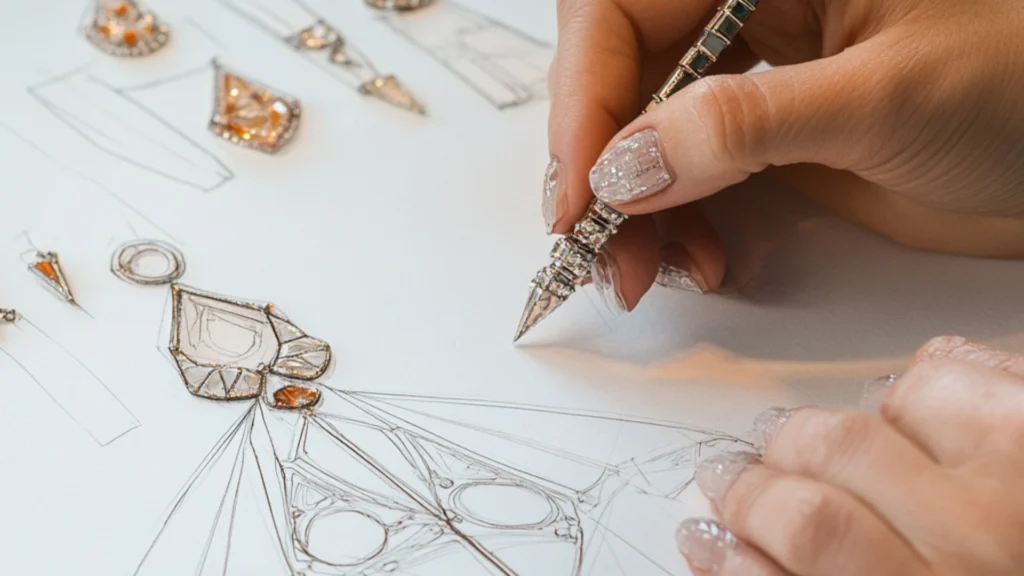
The Dawn of Adornment
Jewelry’s history is as old as civilization itself, tracing humanity’s deep-rooted desire for beauty, symbolism, and self-expression. The earliest forms of jewelry date back over 100,000 years, when primitive societies fashioned adornments from shells, animal bones, feathers, and stones. These early pieces were far from mere decoration—they held spiritual and social meanings.
Archaeological discoveries from prehistoric sites reveal that jewelry often symbolized status, identity, and protection. Hunters wore animal teeth as tokens of strength. Shamans used beads and shells in rituals to ward off evil or attract good fortune. These simple artifacts represent the foundation of a craft that would evolve into one of the most refined art forms in human history.
Ancient Civilizations and the Birth of Ornamentation
Egypt: Symbolism and Sacred Design
Ancient Egypt remains one of the most iconic origins of jewelry design. Egyptians viewed jewelry as both aesthetic and spiritual. Gold, abundant in the Nile region, was associated with the sun god Ra and considered eternal, indestructible, and divine. Pharaohs, queens, and nobles adorned themselves with intricate collars, scarabs, and amulets to signify wealth and divine favor.
Colors held symbolic meaning—lapis lazuli represented royalty and protection, turquoise symbolized rebirth, and carnelian was used to ward off evil. Every piece was more than decoration; it was a talisman of life and eternity. Jewelry also played a vital role in burial customs, ensuring safe passage into the afterlife.
Mesopotamia and Persia: The Age of Technical Mastery
The craftsmen of ancient Mesopotamia were among the first to refine metalworking techniques, introducing wire-making, granulation, and filigree. Jewelry from this region, often made of gold and silver, featured floral motifs and geometric designs that reflected their advanced artistry. Persian jewelers introduced the use of colored gemstones and enamel inlays, blending luxury with innovation. Their creations were symbols of prosperity, frequently exchanged as royal gifts and dowries.
Greece and Rome: Classical Elegance
In ancient Greece, jewelry reflected philosophical ideals of beauty and balance. Greek artisans preferred intricate filigree and repoussé (metal hammered into relief) techniques to achieve delicacy and grace. Jewelry often depicted mythological creatures, gods, and natural motifs like olive leaves or laurel wreaths—symbols of victory and divinity.
The Romans elevated jewelry to a symbol of social hierarchy. Gold rings, cameos, and intaglios became popular among the elite, often engraved with portraits, family crests, or imperial insignias. Emeralds and pearls were especially prized, with Roman women wearing them as expressions of luxury and sophistication.
India and China: Spiritual Symbolism and Cultural Legacy
India’s jewelry tradition dates back over 5,000 years and remains one of the richest in the world. Adornments were deeply intertwined with religion, marriage, and social customs. Gold symbolized purity and immortality, while gemstones were selected for their astrological properties. Each piece carried emotional and spiritual significance, from bridal sets to temple jewelry.
In China, jewelry evolved as an expression of moral values and social order. Jade, revered above gold, represented virtue and harmony. Chinese craftsmen mastered the art of carving jade into symbolic forms such as dragons, phoenixes, and lotus flowers. These designs emphasized spiritual purity and balance, reflecting Confucian and Taoist philosophies.
The Middle Ages: Symbolism and Spiritual Protection
During the medieval period, jewelry became a medium of faith and superstition. The Christian church heavily influenced designs, with crosses, reliquaries, and gemstone-encrusted rosaries serving as religious symbols. Each gemstone was believed to hold spiritual power—sapphires for purity, amethysts for humility, and garnets for protection in battle.
Jewelry also reflected social class. Nobility displayed ornate brooches, crowns, and pendants encrusted with gems, while commoners wore simpler pieces crafted from bronze or pewter. Trade routes such as the Silk Road facilitated the exchange of precious stones and techniques between Europe, Asia, and the Middle East, enriching design diversity.
The Renaissance: The Golden Age of Artistic Innovation
The Renaissance marked a cultural rebirth that transformed jewelry into high art. Influenced by the revival of classical knowledge, artisans combined technical mastery with humanistic themes. Jewelers in Italy, France, and England created pieces inspired by mythology, science, and nature. Goldsmiths like Benvenuto Cellini pioneered new techniques in enameling, engraving, and gemstone cutting.
Gemstones began to be faceted to enhance brilliance. Diamonds, once valued mainly for rarity, gained prominence for their light-reflecting beauty. The elite commissioned intricate pendants, lockets, and jeweled portraits as personal expressions of love, power, and intellect. Jewelry had become both an artistic masterpiece and a reflection of individual identity.
The Baroque and Rococo Eras: Drama and Ornamentation
From the 17th to the 18th centuries, jewelry design embraced extravagance and emotional intensity. The Baroque period favored grandeur—large gemstones, ornate metalwork, and theatrical compositions. Jewelry was often designed to match elaborate clothing, with pearls and colored gems arranged in floral or scroll patterns.
The Rococo era softened this bold aesthetic with romantic and asymmetrical designs. Pastel gemstones, bow motifs, and nature-inspired patterns became popular among European aristocracy. This period also introduced sentimental jewelry, such as lockets containing miniature portraits or hair, symbolizing love and remembrance.
The Victorian and Edwardian Eras: Sentiment and Sophistication
The Victorian era (1837–1901) was defined by emotion and symbolism. Influenced by Queen Victoria’s personal tastes, jewelry reflected themes of love, mourning, and devotion. Early Victorian designs featured floral and heart motifs, while black onyx and jet dominated mourning jewelry after Prince Albert’s death.
Industrial advancements allowed for mass production, making jewelry more accessible to the middle class. The discovery of new gemstone sources, including South African diamonds, revolutionized the industry.
The Edwardian period introduced delicate platinum settings and lace-like filigree. Pearls and diamonds were arranged in elegant, airy designs that symbolized refinement and grace. Jewelry became lighter and more sophisticated, mirroring the social optimism of the early 20th century.
The Art Nouveau and Art Deco Movements
The Art Nouveau movement (1890–1910) celebrated nature and the human form. Designers broke away from rigid symmetry, favoring flowing lines, enameling, and organic motifs like butterflies, dragonflies, and irises. This era blurred the line between jewelry and sculpture, turning each piece into wearable art.
The Art Deco period (1920s–1930s) introduced bold geometry and modernism. Influenced by architecture and industrial design, Art Deco jewelry featured sharp angles, contrasting colors, and materials like platinum, jade, and onyx. This was the age of luxury and innovation, reflecting the spirit of progress and freedom.
Mid-Century Modern to Contemporary Design
After World War II, jewelry became a reflection of global culture and individuality. The 1950s brought a return to glamour, with Hollywood influencing diamond-heavy designs. The 1960s and 1970s ushered in bold experimentation—abstract shapes, mixed materials, and cultural fusion defined the era.
Contemporary jewelry celebrates diversity and self-expression. Sustainability and ethical sourcing have become vital, with consumers demanding transparency in materials and craftsmanship. Modern artisans blend technology with tradition, using 3D printing, recycled metals, and lab-grown gemstones to redefine luxury in a responsible way.
The Legacy of Jewelry’s Evolution
From primitive beads to high-tech craftsmanship, the historical evolution of jewelry design mirrors humanity’s creative and emotional journey. Every era introduced new materials, meanings, and methods, shaping jewelry into a language of identity and artistry. What began as simple adornment has become a symbol of memory, power, and eternal beauty—an unbroken link between the ancient and the modern world.
FAQs
Q1. How did ancient cultures determine the value of jewelry?
Value was based on rarity, craftsmanship, and symbolic meaning. Materials like gold, jade, and gemstones were prized for their natural beauty and believed spiritual power.
Q2. Which historical period influenced modern jewelry the most?
The Renaissance and Art Deco eras profoundly shaped modern design principles, introducing symmetry, gemstone faceting, and creative abstraction still used today.
Q3. Why is gold considered timeless in jewelry design?
Gold’s durability, malleability, and resistance to tarnish make it ideal for crafting intricate designs. Its cultural symbolism of purity and wealth ensures its ongoing popularity.
Q4. What are the most notable jewelry innovations in history?
Innovations include gemstone faceting during the Renaissance, platinum use in the Edwardian period, and the integration of 3D printing and lab-grown gems in contemporary design.
Q5. How has technology changed jewelry craftsmanship today?
Technology allows for unprecedented precision and personalization. Computer-aided design (CAD), 3D modeling, and laser engraving enable jewelers to create complex, custom pieces while preserving traditional artistry.